
Classic experiments explained
Wason Selection task
In short
The Wason Selection Task is a classic reasoning paradigm developed by Peter Wason (1966) to investigate how people test conditional rules. The task examines logical reasoning and hypothesis testing, and it is widely used to demonstrate confirmation bias (the tendency to seek evidence that confirms rather than falsifies a rule). It is a core paradigm in cognitive and reasoning research.
The Wason Selection task
In the standard version of the task, participants are presented with a conditional rule, such as: “If a card has a vowel on one side, then it has an even number on the other side”. Four cards are displayed, each showing one side only (e.g., A, D, 4, 7). Participants must select which card(s) need to be turned over to test whether the rule is true.
Critically, only certain cards can logically falsify the rule. However, many participants select cards that would confirm rather than falsify it. Variations of the task use abstract symbols, thematic content (e.g., social rules), or real-world scenarios.
Responses are typically recorded as selections, and accuracy is measured against the logically correct solution.
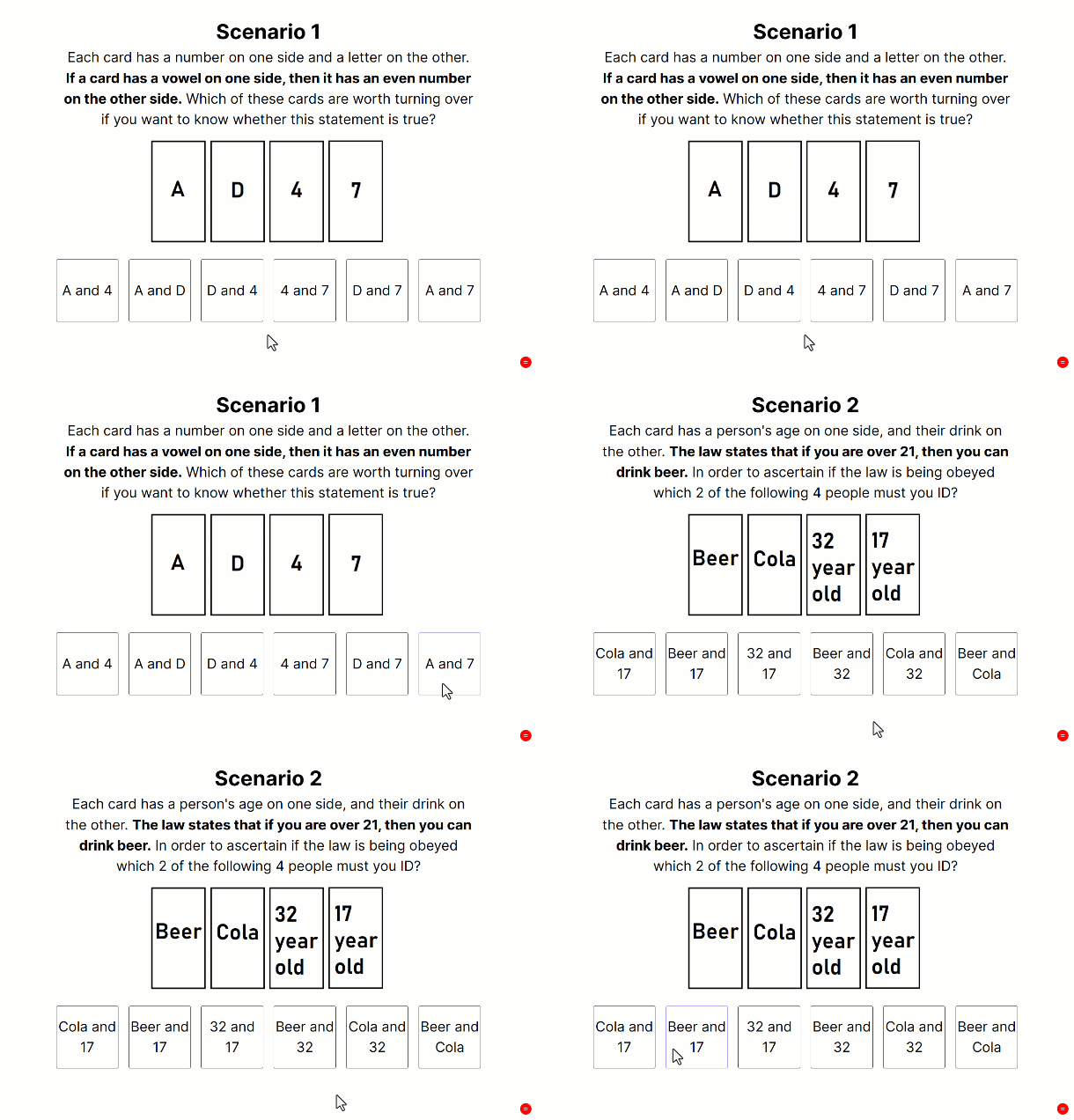
What is the Wason Selection effect?
The key finding is that participants often fail to select the logically correct cards, particularly in abstract versions of the task. Accuracy rates are typically low unless the rule is framed in a familiar or social context.
The dependent measure is usually the proportion of logically correct selections. Performance differences between abstract and contextualised versions illustrate reasoning biases.
What is the theory behind the Wason Selection task?
The task has been interpreted through several theoretical lenses. Confirmation bias suggests individuals preferentially seek evidence that supports existing hypotheses. Mental models theory (Johnson-Laird, 1983) proposes that people construct incomplete internal representations of logical rules. Pragmatic reasoning accounts (Cheng & Holyoak, 1985) argue that performance improves when rules align with familiar social contracts.
The paradigm therefore provides a powerful demonstration that human reasoning is not purely formal or logical, but shaped by context and cognitive heuristics.
Can I use Wason Selection tasks in online research?
Yes, absolutely! In fact, other researchers have already used the Wason Selection task to study unequal rewards and the cognitive basis of redistribution using an incentivised Wason Selection task (Blouin et al., 2025).
How does it work in Gorilla?
You can try out and clone our sample of a Wason Selection task. Of course, you can also tweak this sample to use your own stimuli.
| Task Builder 2 | Try as participant | View/Edit in Gorilla |
Are there any papers Gorilla users have written about Wason Selection tasks?
Yes there is! Have a look at the following article:
The meritocratic illusion: inequality and the cognitive basis of redistribution
References
Blouin, A., Mani, A., Mukand, S. W., & Sgroi, D. (2025). The meritocratic illusion: inequality and the cognitive basis of redistribution. Oxford Economic Papers, 77(4), 1128-1147. https://doi.org/10.1093/oep/gpaf014
Cheng, P. W., & Holyoak, K. J. (1985). Pragmatic reasoning schemas. Cognitive Psychology, 17(4), 391-416. https://doi.org/10.1016/0010-0285(85)90014-3
Johnson-Laird, P. N. (1983). Mental models: Towards a cognitive science of language, inference, and consciousness. Harvard University Press.
Wason, P. C. (1968). Reasoning about a rule. Quarterly Journal of Experimental Psychology, 20(3), 273-281. https://doi.org/10.1080/14640746808400161