
Classic experiments explained
Visual Search
In short
The Visual Search task investigates how efficiently individuals locate a target item among distractors. Emerging from foundational work by Treisman and Gelade (1980), the paradigm is central to theories of attention and perceptual processing. It is widely used in cognitive psychology to distinguish between parallel and serial attentional processes.
The Visual Search task
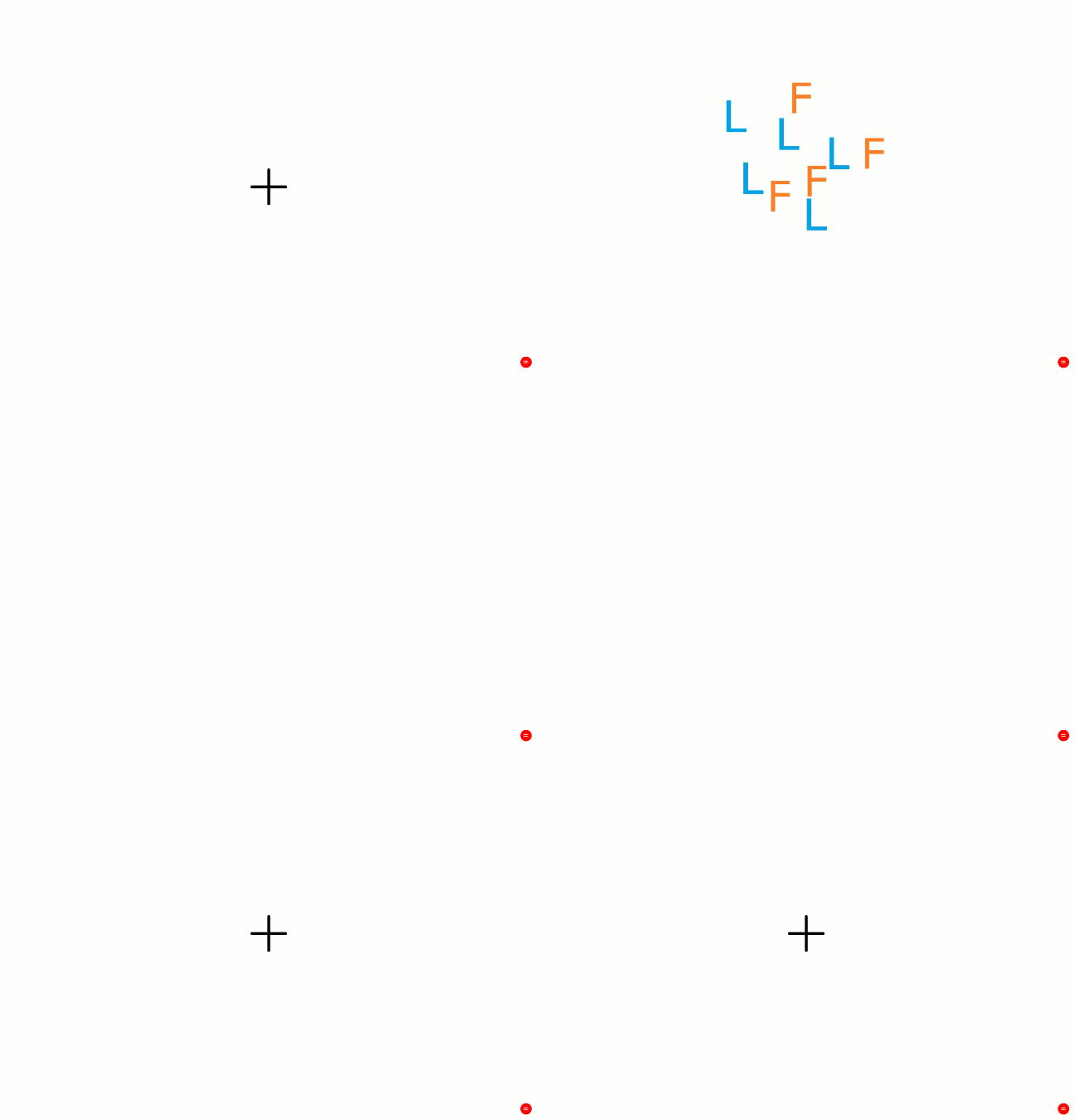
Participants are presented with an array of stimuli and asked to determine whether a target is present or absent. Displays may vary in the number of distractors and in whether the target differs by a single feature (e.g., colour) or a conjunction of features (e.g., colour and shape).
Reaction time and accuracy are recorded. By manipulating display size and target-distractor similarity, researchers examine search efficiency.
Feature search tasks typically produce rapid responses independent of set size, while conjunction search tasks often show increasing reaction times as display size increases.
What is the Visual Search effect?
The key outcome is the relationship between reaction time and set size. Efficient (parallel) search yields flat search slopes, while inefficient (serial) search yields increasing reaction times as distractors increase.
What is the theory behind Visual Search?
Feature Integration Theory (Treisman and Gelande, 1980) proposes that simple features are processed automatically in parallel, but feature conjunctions require focused attention. Later models, such as Guided Search Theory (J.M. Wolfe, K.R Cave and S.L Franzel, 1989), suggest that search is guided by both bottom-up salience and top-down goals.
Can I use Visual Search Tasks in online research?
Yes, absolutely! In fact, other researchers have already used Visual Search tasks in their own research. Have a look in the papers section below for more information.
How does it work in Gorilla?
You can try out and clone our sample of a Visual Search task. Of course, you can also tweak this sample to use your own stimuli.
| Task Builder 2 | Try as participant | View/Edit in Gorilla |
Are there any papers Gorilla users have written about Visual Search?
Yes, there are! Have a look at the following articles:
A limited visual search advantage for illusory faces
Long-term memory and working memory compete and cooperate to guide attention
Working memory guidance of visual attention to threat in offenders
References
Collyer, L., Ireland, J., & Susilo, T. (2024). A limited visual search advantage for illusory faces. Attention, Perception, & Psychophysics, 86(3), 717-730. https://doi.org/10.3758/s13414-023-02833-y
Hirschstein, Z., & Aly, M. (2023). Long-term memory and working memory compete and cooperate to guide attention. Attention, Perception, & Psychophysics, 85(5), 1517-1549. https://doi.org/10.3758/s13414-022-02593-1
Satmarean, T. S., Milne, E., & Rowe, R. (2022). Working memory guidance of visual attention to threat in offenders. PLOS ONE, 17(1), e0261882. https://doi.org/10.1371/journal.pone.0261882
Treisman, A. M., & Gelade, G. (1980). A feature-integration theory of attention. Cognitive Psychology, 12(1), 97-136. https://doi.org/10.1016/0010-0285(80)90005-5
Wolfe, J. M., Cave, K. R., & Franzel, S. L. (1989). Guided search: An alternative to the feature integration model for visual search. Journal of Experimental Psychology: Human perception and performance, 15(3), 419. https://doi.org/10.1037/0096-1523.15.3.419