
Classic experiments explained
Thatcher
In short
The Thatcher Task is based on the Thatcher Illusion, first reported by Thompson (1980). The illusion demonstrates that grotesque distortions in faces (typically inverted eyes and mouth within an upright face) are surprisingly difficult to detect when the whole face is presented upside down. The task is widely used in research on face perception, configural processing, and holistic processing, and provides a powerful demonstration of the orientation-specific mechanisms underlying human face recognition.
The Thatcher Task
In a typical Thatcher Task, participants are shown faces in either upright or inverted orientation. Some faces are normal, while others are “Thatcherised,” meaning that the eyes and/or mouth have been rotated 180 degrees within the face. When the face is upright, the distortions appear highly unnatural. However, when the entire face is inverted, these distortions are much harder to detect.
Participants are usually asked to judge whether a face looks normal or distorted, or to rate how strange the face appears. Reaction time and accuracy are recorded. Variations of the task may manipulate face familiarity, emotional expression, or presentation duration.
The key manipulation is face orientation, allowing researchers to compare performance between upright and inverted conditions.
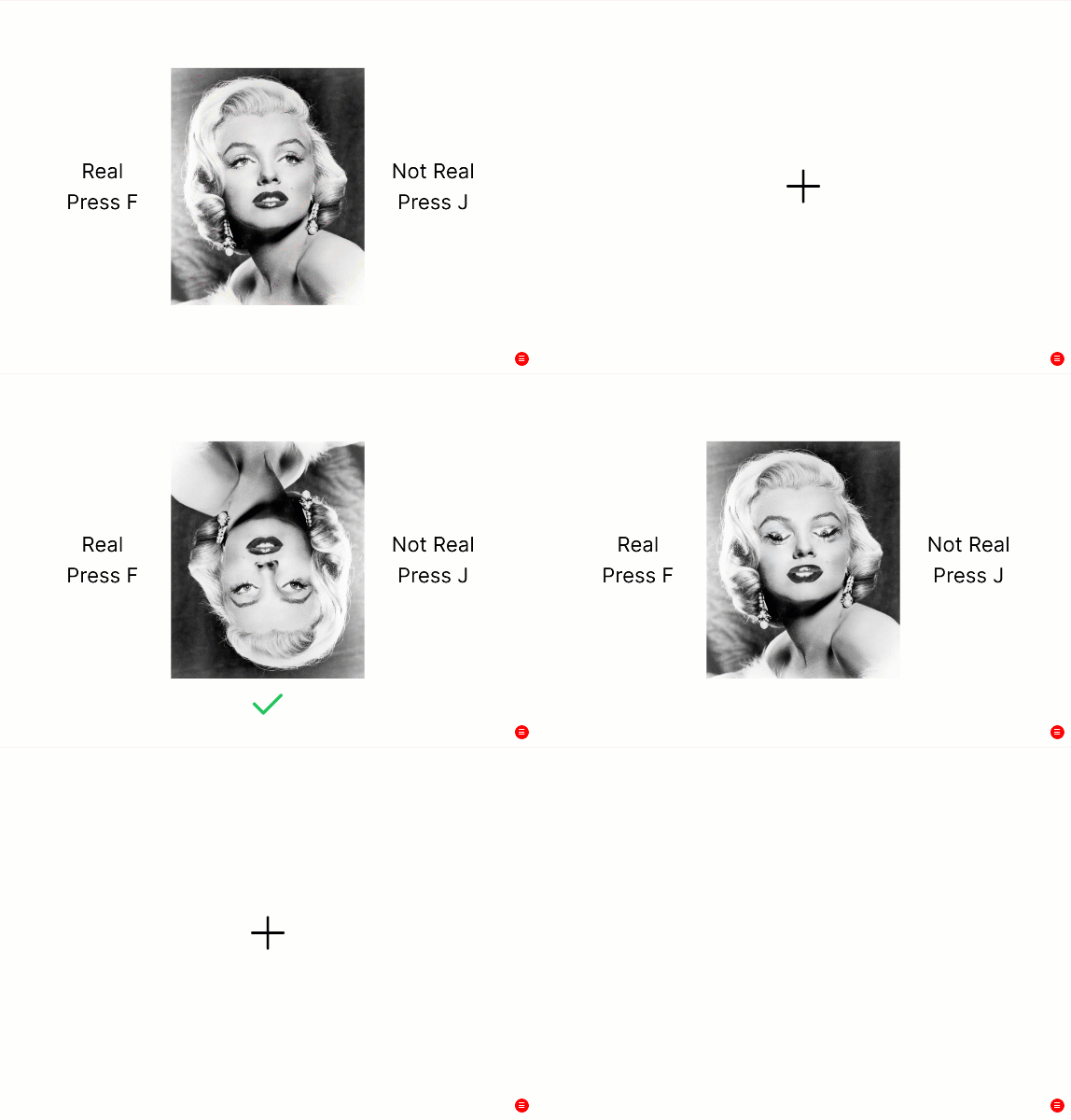
What is the Thatcher effect?
The Thatcher Effect refers to the dramatic reduction in sensitivity to local facial distortions when a face is inverted. Participants are typically faster and more accurate at detecting distortions in upright faces than inverted faces.
The primary dependent variable is the difference in detection accuracy or reaction time between upright and inverted conditions. This orientation-specific difference reflects the disruption of normal face-processing mechanisms.
What is the theory behind the Thatcher effect?
The Thatcher Effect supports theories of configural or holistic face processing (Searcy & Bartlett, 1996). Human face perception relies heavily on the spatial relationships between facial features, such as the distance between the eyes and alignment of the mouth and nose. When a face is inverted, these configural processes are disrupted, causing participants to rely more heavily on the analysis of individual facial features. As a result, distortions that appear striking in upright faces are often less readily detected when faces are inverted.
The illusion demonstrates that face perception is not simply the sum of individual features but depends on orientation-sensitive mechanisms specialised for upright faces. The task is often used to teach the distinction between featural and configural processing.
Can I use the Thatcher task in online research?
Yes, absolutely! In fact, other researchers have already used the Thatcher task as a distractor task in a study exploring the impact of grammatical gender on memory recall in Ukrainian-Russian simultaneous bilinguals (Osypenko, Brandt & Athanasopoulos, 2025).
How does it work in Gorilla?
You can try out and clone our sample of a Thatcher task. Of course, you can also tweak this sample to use your own stimuli.
| Task Builder 2 | Try as participant | View/Edit in Gorilla |
Are there any papers Gorilla users have written using the Thatcher task?
Yes, there is! Have a look at the following article:
References
Osypenko, O., Brandt, S., & Athanasopoulos, P. (2025). Between two grammatical gender systems: Exploring the impact of grammatical gender on memory recall in Ukrainian− Russian simultaneous bilinguals. Cognitive Science, 49(10), e70117. https://doi.org/10.1111/cogs.70117
Searcy, J. H., & Bartlett, J. C. (1996). Inversion and processing of component and spatial–relational information in faces. Journal of Experimental Psychology: Human Perception and Performance, 22(4), 904. https://psycnet.apa.org/doi/10.1037/0096-1523.22.4.904
Thompson, P. (1980). Margaret Thatcher: A new illusion. Perception, 9(4), 483-484. https://doi.org/10.1068/p090483