
Classic experiments explained
Remote Associates
In short
The Remote Associates Test (RAT), developed by Mednick (1962), is a widely used measure of creative problem solving and associative thinking. Participants must identify a single word that links three seemingly unrelated cue words. The task is used in research on creativity, semantic memory, and convergent thinking, and is frequently incorporated into undergraduate teaching on higher cognition.
The Remote Associates Test
In a typical RAT trial, participants are presented with three words (e.g., “cottage,” “swiss,” “cake”) and must generate a fourth word that connects them (e.g., “cheese”). The correct solution forms a compound word or meaningful association with each cue.
Trials are usually time-limited, and responses are recorded either as typed answers or multiple-choice selections. The task can vary in difficulty depending on the associative distance between the cue words.
Performance is measured through accuracy and, in some designs, response time to solution.
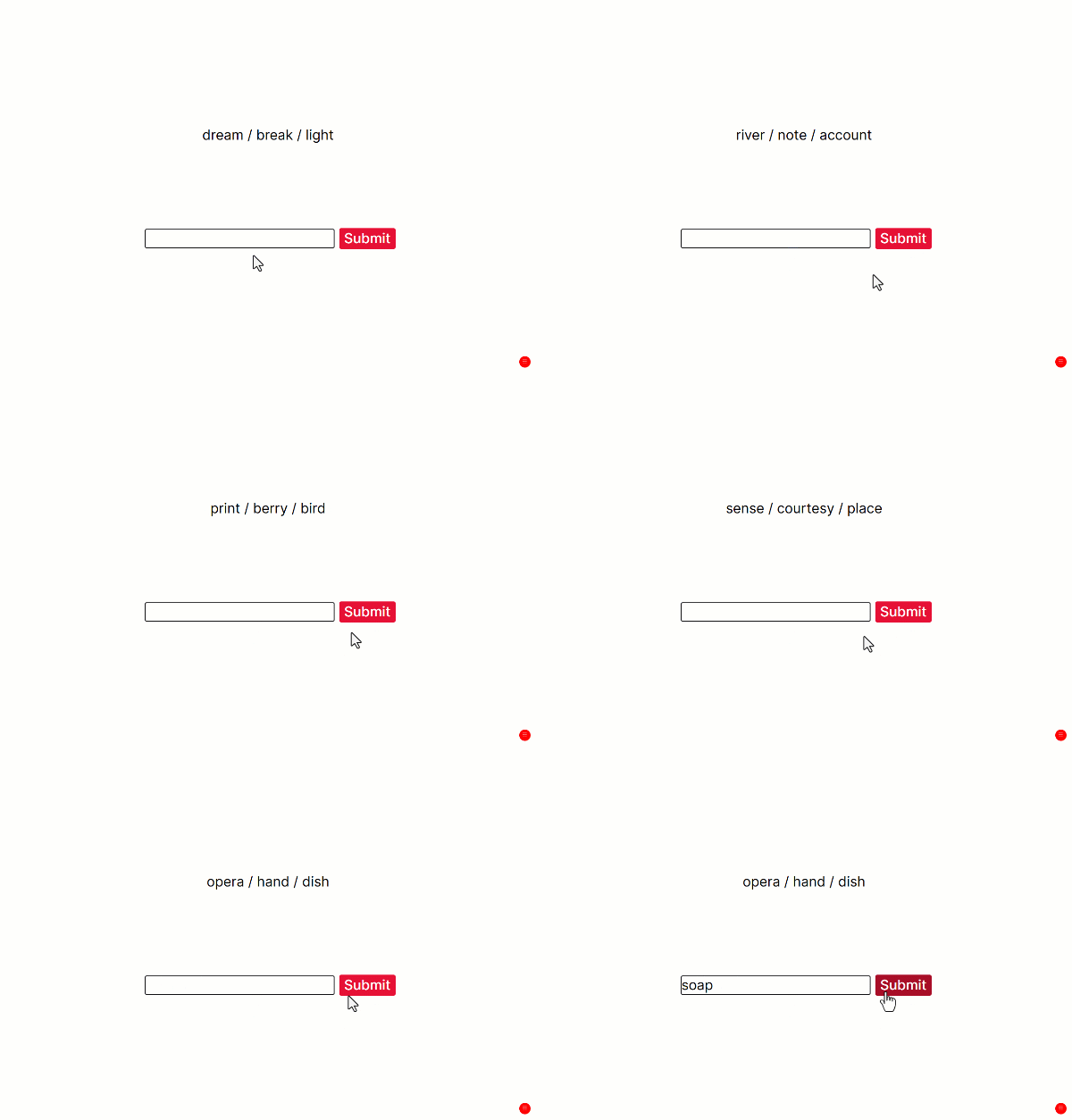
What does the RAT measure?
The primary outcome is the proportion of correctly solved items. Response time can also indicate problem-solving efficiency.
The RAT is considered a measure of convergent creativity, as it requires generating a single correct solution rather than multiple possible responses.
What is the theory behind the RAT?
The RAT is grounded in Mednick's (1962) associative theory of creativity. Creative problem solving is thought to involve activation spreading through semantic networks (Collins & Loftus, 1975), with successful solutions emerging when remote associations are accessed.
Individual differences in creativity may reflect the breadth and flexibility of associative connections.
Can I use the RAT in online research?
Yes, absolutely! In fact, other researchers have already used Remote Associate tasks in their own research. Have a look in the papers section below for more information.
How does it work in Gorilla?
You can try out and clone our sample of a Remote Associates Test. Of course, you can also tweak this sample to use your own stimuli.
| Task Builder 2 | Try as participant | View/Edit in Gorilla |
Are there any papers Gorilla users have written about the RAT?
Yes, there are! Have a look at the following articles:
Effects of task characteristics and task-switching on remote associates test problem solving
The Impact of Adding a Fourth Item to the Traditional 3-Item Remote Associates Test
References
Collins, A. M., & Loftus, E. F. (1975). A spreading-activation theory of semantic processing. Psychological Review, 82(6), 407. https://doi.org/10.1037/0033-295X.82.6.407
Diaz, J. A., Nelson, S. M., Beaujean, A. A., Green, A. E., & Scullin, M. K. (2024). The impact of adding a fourth item to the traditional 3-item remote associates test. Creativity Research Journal, 36(4), 604-616. https://doi.org/10.1080/10400419.2023.2200597
Mednick, S. (1962). The associative basis of the creative process. Psychological Review, 69(3), 220. https://doi.org/10.1037/h0048850
Sio, U. N., Lortie-Forgues, H., & Marsh, J. E. (2024). Effects of task characteristics and task-switching on remote associates test problem solving. Journal of Cognitive Psychology, 36(5), 595-616. https://doi.org/10.1080/20445911.2024.2333580
Sio, U. N., Kotovsky, K., & Cagan, J. (2022). Determinants of creative thinking: the effect of task characteristics in solving remote associate test problems. Thinking & Reasoning, 28(2), 163-192. https://doi.org/10.1080/13546783.2021.1959400
Tong, K., Chan, Y. N., Cheng, X., Cheon, B., Ellefson, M., Fauziana, R., ... & CLIC Phase 1 Consortium. (2023). Study protocol: How does cognitive flexibility relate to other executive functions and learning in healthy young adults?. PLOS ONE, 18(7), e0286208. https://doi.org/10.1371/journal.pone.0286208