
Classic experiments explained
Iowa Gambling Task
In short
The Iowa Gambling Task (IGT), developed by Bechara et al. (1994), assesses decision making under uncertainty. Participants choose from decks of cards associated with different reward and punishment structures. The task is widely used to study learning, risk evaluation, and affective influences on decision making. It is also used to investigate decision-making deficits in people with brain damage and other pathologies.
The Iowa Gambling Task
Participants select cards from four decks. Some decks yield high immediate rewards but larger long-term losses, while others provide smaller gains but more favourable long-term outcomes.
Over repeated trials, participants must learn which decks are advantageous. Performance is measured by net score (advantageous minus disadvantageous selections) across blocks of trials. Feedback on winnings and losses is typically presented after each deck selection.
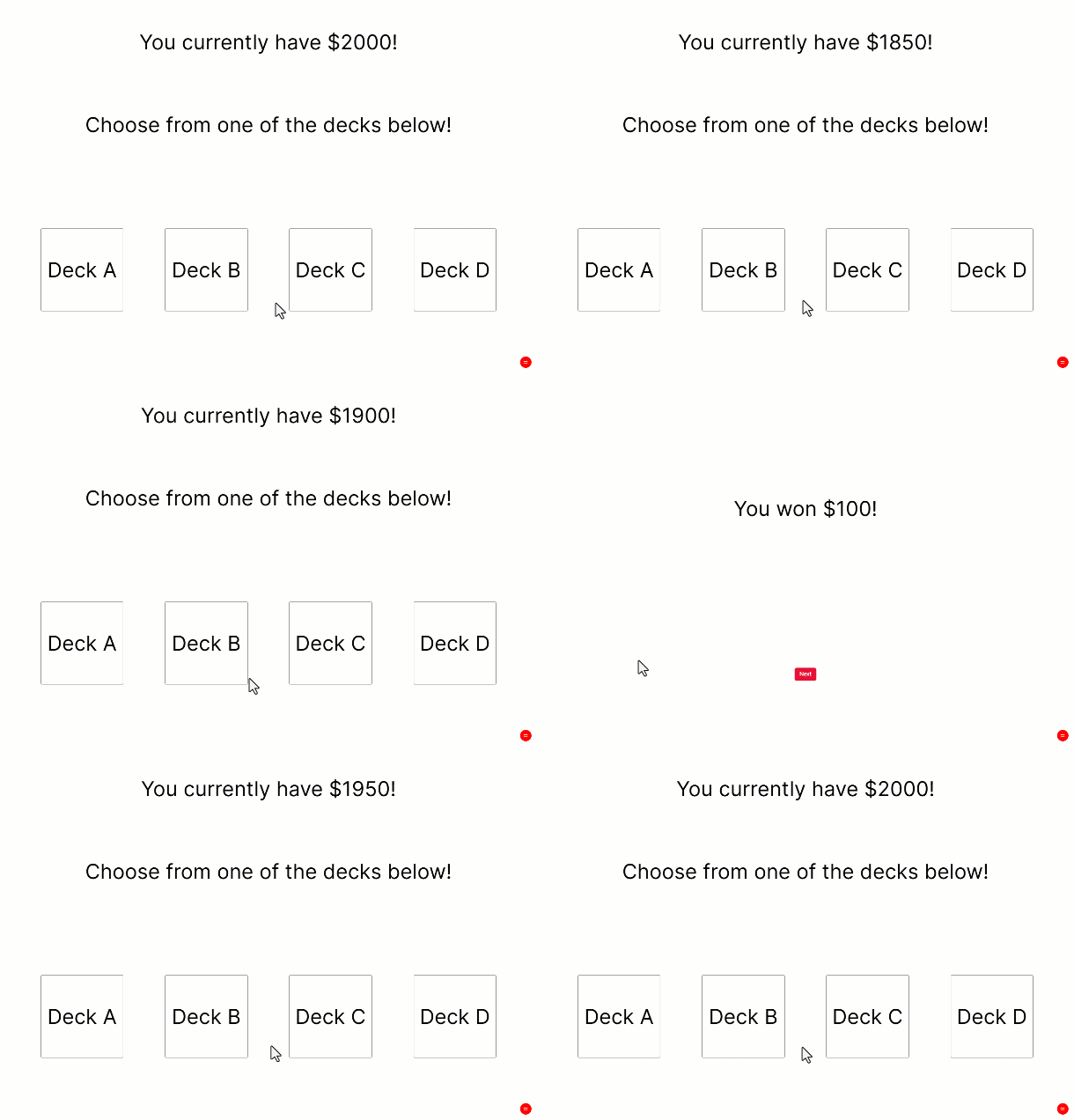
What does the Iowa Gambling Task measure?
The key measure is the tendency to shift toward advantageous decks over time. Participants' net score across blocks reflects adaptive decision making. Healthy participants typically learn to prefer long-term beneficial options, whereas participants with damage to the ventromedial prefrontal cortex (vmPFC) typically ignore long-term benefits and make decisions based on short-term benefits only.
What is the theory behind the Iowa Gambling task?
One explanation of the difference between healthy participants and vmPFC patients is the Somatic Marker Hypothesis (Damasio, 1994), which proposes that emotional signals guide advantageous decisions. The task has also been interpreted through later reinforcement-learning accounts, such as the Expectancy-Valence model proposed by Busemeyer and Stout (2002), in which feedback from gains and losses is used to update expectations about each deck and guide future choices.
Can I use an Iowa Gambling task in online research?
Yes, absolutely! In fact, other researchers have already used Iowa Gambling tasks in their own research. Have a look in the papers section below for more information.
How does it work in Gorilla?
You can try out and clone our sample of an Iowa Gambling task. Of course, you can also tweak this sample to use your own stimuli.
| Task Builder 2 | Try as participant | View/Edit in Gorilla |
Are there any papers Gorilla users have written about the Iowa Gambling Task?
Yes, there are! Have a look at the following articles:
Driving safety: Investigating the cognitive foundations of accident prevention
Social isolation during COVID-19 lockdown impairs cognitive function
References
Bechara, A., Damasio, A. R., Damasio, H., & Anderson, S. W. (1994). Insensitivity to future consequences following damage to human prefrontal cortex. Cognition, 50(1-3), 7-15. https://doi.org/10.1016/0010-0277(94)90018-3
Busemeyer, J. R., & Stout, J. C. (2002). A contribution of cognitive decision models to clinical assessment: Decomposing performance on the Bechara gambling task. Psychological Assessment, 14(3), 253. https://psycnet.apa.org/doi/10.1037/1040-3590.14.3.253
Damasio, A. R. (1994) Descartes’ Error: Emotion, Reason, and the Human Brain. Putnam.
Ingram, J., Hand, C. J., & Maciejewski, G. (2021). Social isolation during COVID‐19 lockdown impairs cognitive function. Applied Cognitive Psychology, 35(4), 935-947. https://doi.org/10.1002/acp.3821
Kildahl, N., Hansen, S., Brevers, D., & Skewes, J. (2020). Individual differences in learning during decision-making may predict specific harms associated with gambling. Addictive Behaviors, 110, 106496. https://doi.org/10.1016/j.addbeh.2020.106496
Tapia, J. L., & Duñabeitia, J. A. (2023). Driving safety: Investigating the cognitive foundations of accident prevention. Heliyon, 9(11). https://doi.org/10.1016/j.heliyon.2023.e21355