
Classic experiments explained
Delay Discount
In short
Delay Discount tasks examine how individuals value rewards over time. Participants choose between smaller immediate rewards and larger delayed rewards, revealing how future outcomes are discounted. The paradigm is widely used in behavioural economics and psychology to study impulsivity, self-control, and decision making.
The Delay Discounting task
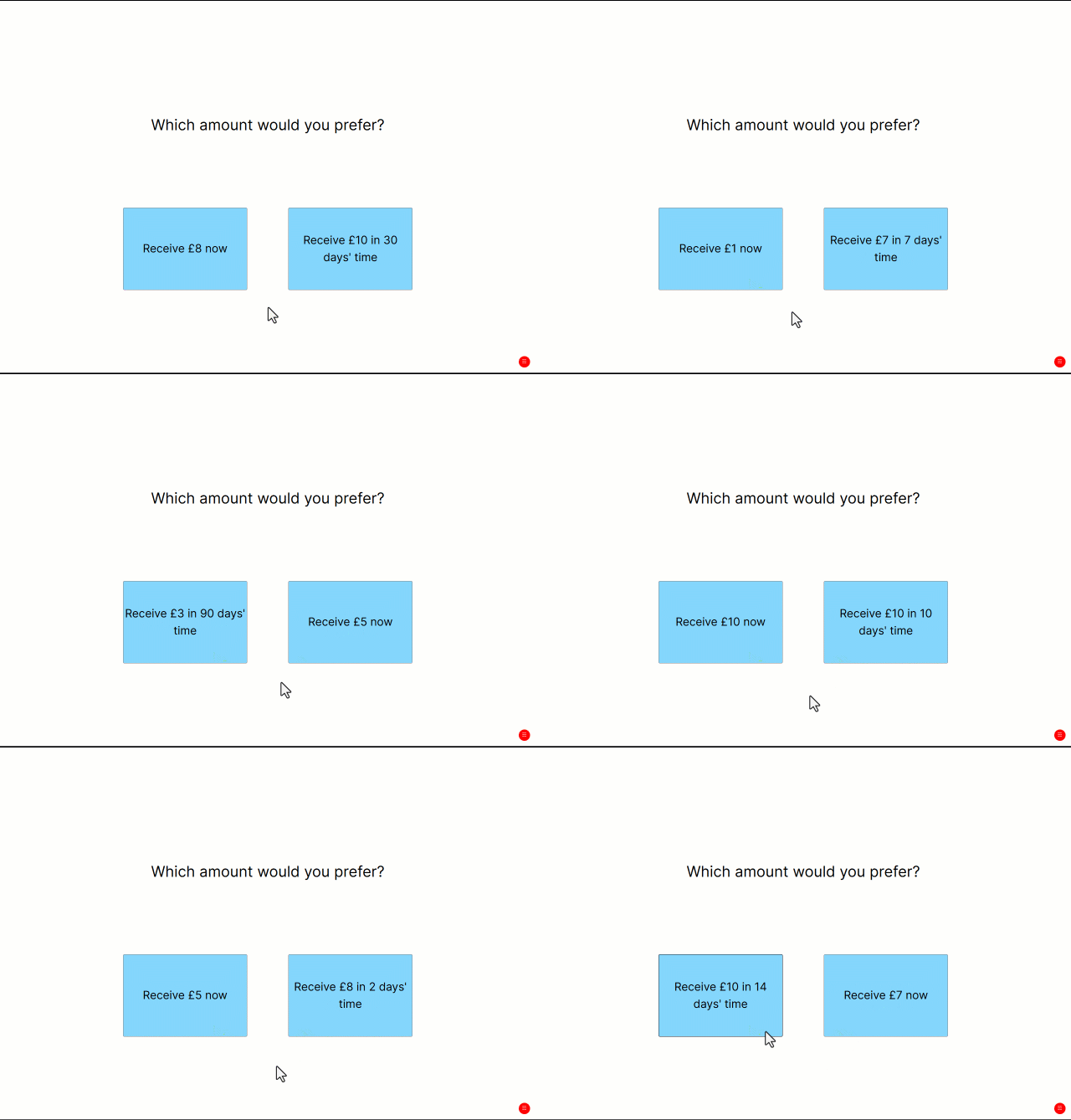
Participants complete a series of choices between two options, such as receiving £5 today or £10 in one week. The immediate reward amount or delay period varies systematically across trials.
By examining switching points between immediate and delayed options, researchers estimate an individual’s discount rate. Some versions use hypothetical rewards, while others involve real incentives.
The primary measures are choice patterns across delays and derived discounting parameters.
What is Delay Discounting?
Delay discounting refers to the tendency to reduce the subjective value of a reward as the delay to receiving it increases. Steeper discounting indicates stronger preference for immediate rewards. Discount rates are often modelled using hyperbolic or exponential functions.
What is the theory behind Delay Discounting?
The paradigm is rooted in behavioural economics and dual-system theories of decision making (McClure et al., 2004). One account suggests competition between impulsive and deliberative systems. Others emphasise subjective time perception or reward valuation mechanisms. Delay discounting is also studied in relation to addiction and self-regulation.
Can I use Delay Discount tasks in online research?
Yes, absolutely! In fact, other researchers have already used Delay Discount tasks in their own research. Have a look in the papers section below for more information.
How does is work in Gorilla?
You can try out and clone our sample of a Delay Discount task. Of course, you can also tweak this sample to use your own stimuli.
| Task Builder 2 | Try as participant | View/Edit in Gorilla |
Are there any papers Gorilla users have written about Delay Discounting?
Yes, there are! Have a look at the following articles:
The Blursday database as a resource to study subjective temporalities during COVID-19
Repeated simulation increases belief in the future occurrence of uncertain events
References
Chaumon, M., Rioux, P. A., Herbst, S. K., Spiousas, I., Kübel, S. L., Gallego Hiroyasu, E. M., ... & van Wassenhove, V. (2022). The Blursday database as a resource to study subjective temporalities during COVID-19. Nature Human Behaviour, 6(11), 1587-1599. https://doi.org/10.1038/s41562-022-01419-2
Garcia Jimenez, C., Mazzoni, G., & D’Argembeau, A. (2023). Repeated simulation increases belief in the future occurrence of uncertain events. Memory & Cognition, 51(7), 1593-1606. https://doi.org/10.3758/s13421-023-01414-6
Lloyd, A., McKay, R., Hartman, T. K., Vincent, B. T., Murphy, J., Gibson-Miller, J., ... & Mason, L. (2021). Delay discounting and under-valuing of recent information predict poorer adherence to social distancing measures during the COVID-19 pandemic. Scientific Reports, 11(1), 19237. https://doi.org/10.1038/s41598-021-98772-5
McClure, S. M., Laibson, D. I., Loewenstein, G., & Cohen, J. D. (2004). Separate neural systems value immediate and delayed monetary rewards. Science, 306(5695), 503-507.https://doi.org/10.1126/science.1100907