
Classic experiments explained
Change Blindness
In short
Change Blindness refers to the striking failure to notice substantial changes in a visual scene, particularly when those changes coincide with a brief visual disruption. Popularised by research in the 1990s (Rensink, O’Regan, & Clark, 1997), the paradigm is widely used to investigate visual awareness, attention and the limits of perceptual representation. It demonstrates that people do not maintain a complete, detailed internal model of their environment.
The Change Blindness task
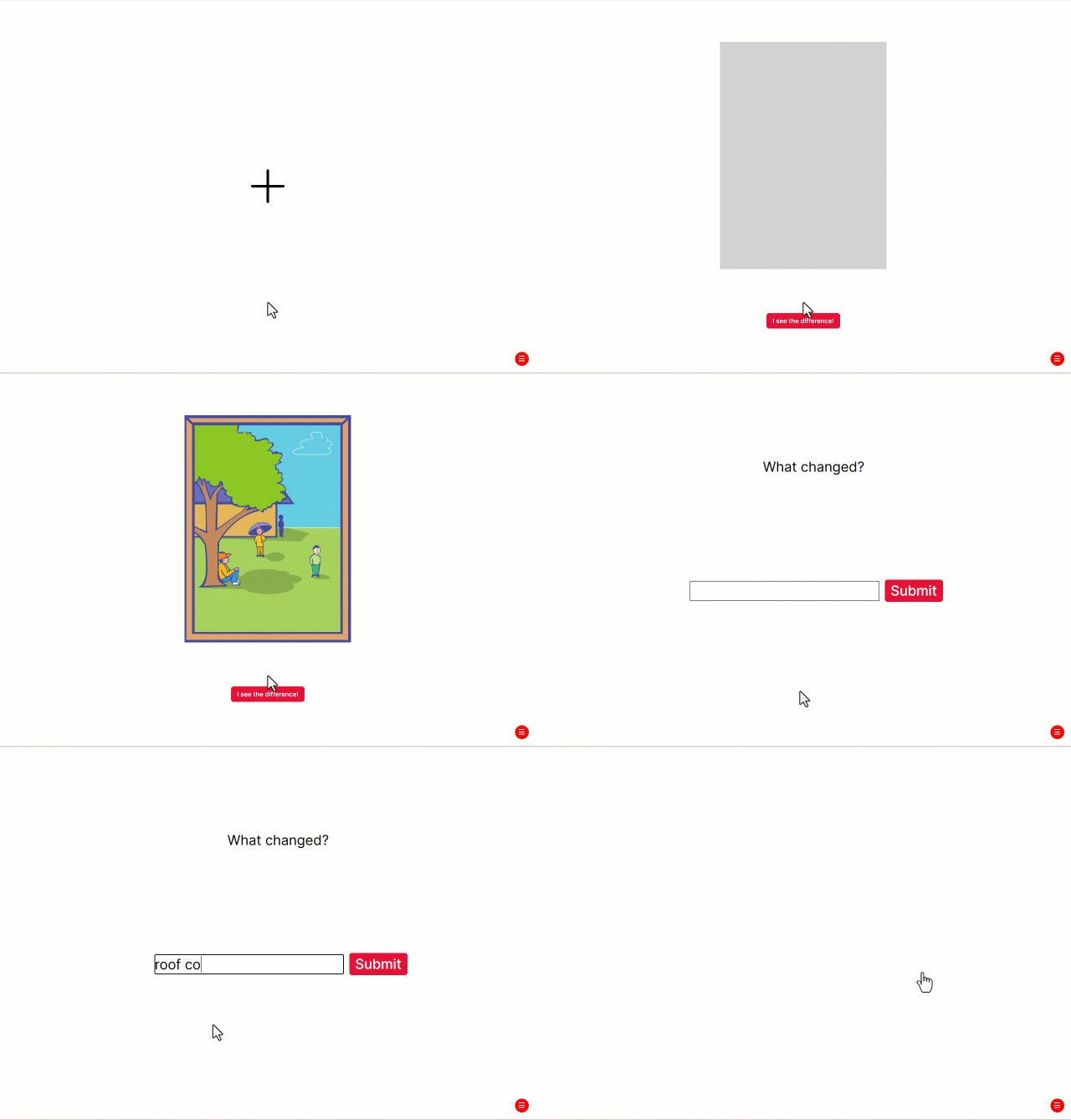
In a typical Change Blindness task, participants are presented with alternating versions of an image separated by a brief interruption, such as a blank screen or a mask. This is often referred to as the 'flicker paradigm'. One element of the image changes between presentations, such as the removal of an object, a colour shift or a spatial change.
Participants are asked to detect the change and either indicate when they noticed it or explain what has changed. Reaction times and accuracy are recorded. Some variations include time-limited presentations or forced-choice detection trials. Modern versions may use photographs or computer-generated displays. The paradigm can also be adapted to investigate social attention, object memory, or attentional prioritisation.
What is the Change Blindness effect?
The Change Blindness effect refers to the consistent delay or failure in detecting changes within a scene. Detection times are often surprisingly long, even when changes are substantial and centrally located.
The key dependent variable is typically detection latency (the time taken to detect the change) or proportion of correctly identified changes. High error rates and delayed responses illustrate the limits of visual awareness.
What is the theory behind Change Blindness?
Change Blindness challenges the idea that visual perception is rich and detailed. Theoretical accounts suggest that detailed representations are constructed only for attended elements, while unattended information is not fully encoded into working memory.
Feature Integration theory (Treisman and Gelade, 1980) and broader models of visual attention propose that attention is required to bind features into coherent object representations. Without focused attention, changes may not be integrated into conscious awareness. The paradigm also supports theories suggesting perception is selective and reconstructive rather than exhaustive.
Can I use a Change Blindness Task in online research?
Yes, absolutely! In fact, other researchers have already used Change Blindness tasks in their own research. Have a look in the papers section below for more information.
How does it work in Gorilla?
You can try out and clone our sample of a Change Blindness task. Of course, you can also tweak this sample to use your own stimuli.
| Task Builder 2 | Try as participant | View/Edit in Gorilla |
Are there any papers Gorilla users have written about Change Blindness?
Yes, there are! Have a look at the following articles:
Animate monitoring is not uniform: implications for the animate monitoring hypothesis
References
Balogh, A., Lewis, G., Shafran, R., & Robinson, O. J. (2024). Change blindness, reward bias, negative affective priming: Exploring individual‐level associations between depression/anxiety symptoms and cognition. Mental Health Science, 2(3), e70. https://doi.org/10.1002/mhs2.70
Loucks, J., Reise, B., Gahite, R., & Fleming, S. (2023). Animate monitoring is not uniform: implications for the animate monitoring hypothesis. Frontiers in Psychology, 14, 1146248. https://doi.org/10.3389/fpsyg.2023.1146248
Rensink, R. A., O'regan, J. K., & Clark, J. J. (1997). To see or not to see: The need for attention to perceive changes in scenes. Psychological Science, 8(5), 368-373. https://doi.org/10.1111/j.1467-9280.1997.tb00427.x
Treisman, A. M., & Gelade, G. (1980). A feature-integration theory of attention. Cognitive Psychology, 12(1), 97-136. https://doi.org/10.1016/0010-0285(80)90005-5