
Classic experiments explained
Balloon Analogue Risk Task (BART)
In short
The Balloon Analogue Risk Task (BART), introduced by Lejuez et al. (2002), measures risk-taking behaviour in a dynamic environment. Participants inflate a virtual balloon to earn rewards, with each pump increasing both potential gains and risk of explosion. The task models real-world risk-taking under uncertainty.
The BART
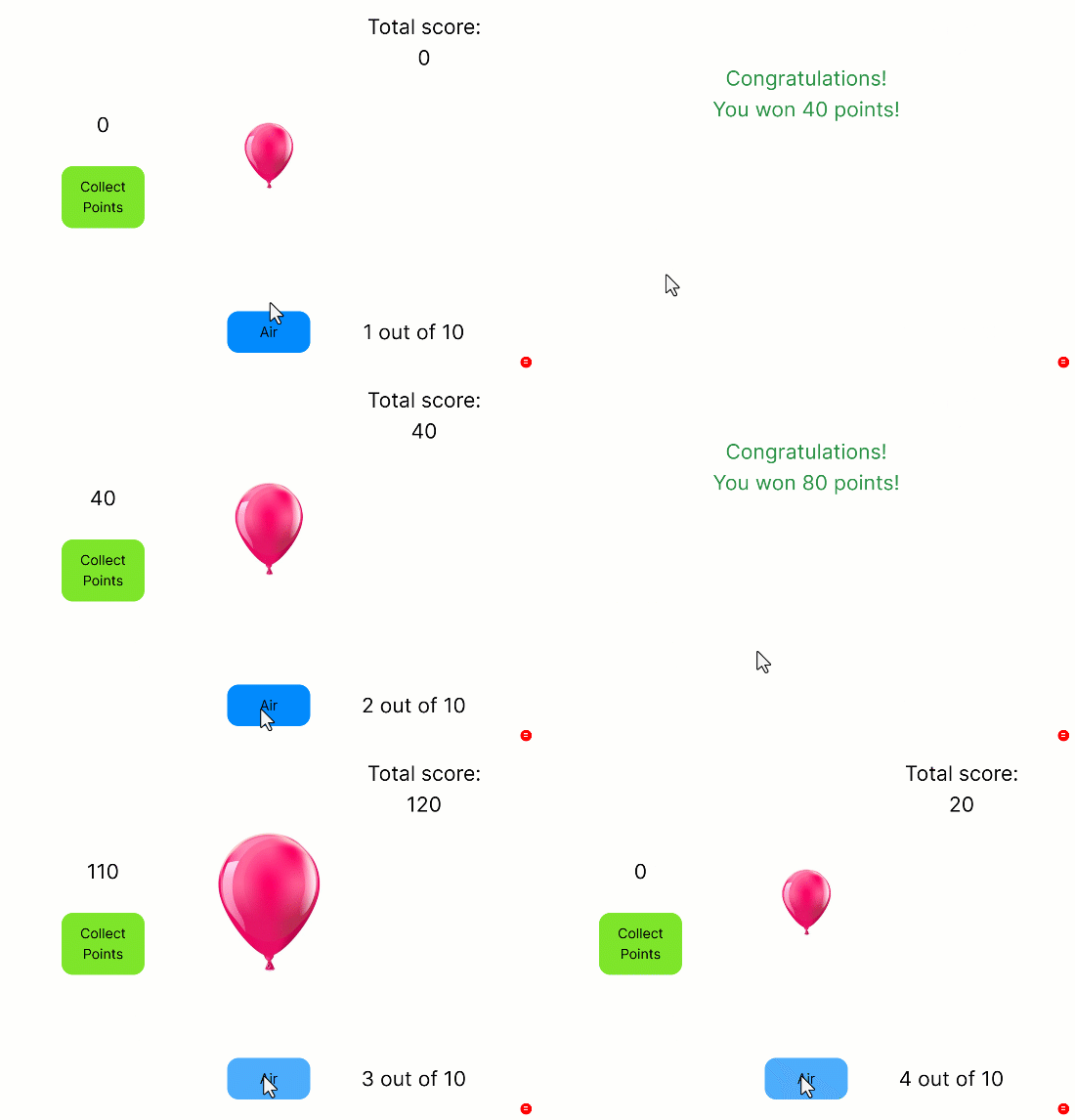
On each trial, participants press a button to inflate a balloon. Each pump increases accumulated reward, but the balloon may explode unpredictably. If it explodes, the reward for that trial is lost. In some tasks, a point deduction may also be applied for balloon explosions. Participants can choose to “cash out” before the explosion to collect their reward.
The average number of pumps on unexploded balloons serves as the primary dependent variable.
What does the BART measure?
The key measure of the BART is the average number of pumps before cashing out. Participants with higher averages exhibit greater risk-taking behaviour. A benefit of the BART is that it captures behavioural risk, rather than self-reported attitudes.
What is the theory behind it?
The BART is grounded in behavioural risk models and reinforcement learning. It captures sensitivity to reward, punishment, and uncertainty, and is often used in research on impulsivity and individual differences.
Can I use the BART in online research?
Yes, absolutely! In fact, other researchers have already used the BART in their own research. Have a look in the papers section below for more information.
How does it work in Gorilla?
You can try out and clone our sample of a BART. Of course, you can also tweak this sample to use your own stimuli.
| Task Builder 2 | Try as participant | View/Edit in Gorilla |
Are there any papers Gorilla users have written about BART?
Yes, there are! Have a look at the following articles:
Catastrophizing and Risk-Taking
Individuals with adverse childhood experiences explore less and underweight reward feedback
References
Lee, H., Haffner, S., Auyeung, B., & Chevalier, N. (2025). Beyond risk reduction: Exploring the relation of cognitive control with adolescent positive and negative risk‐taking. Journal of Research on Adolescence, 35(4), e70103. https://doi.org/10.1111/jora.70103
Lejuez, C. W., Read, J. P., Kahler, C. W., Richards, J. B., Ramsey, S. E., Stuart, G. L., ... & Brown, R. A. (2002). Evaluation of a behavioral measure of risk taking: the Balloon Analogue Risk Task (BART). Journal of Experimental Psychology: Applied, 8(2), 75. https://doi.org/10.1037/1076-898x.8.2.75
Lloyd, A., McKay, R. T., & Furl, N. (2022). Individuals with adverse childhood experiences explore less and underweight reward feedback. Proceedings of the National Academy of Sciences, 119(4), e2109373119. https://doi.org/10.1073/pnas.2109373119
Pike, A. C., Anet, Á. A., Peleg, N., & Robinson, O. J. (2023). Catastrophizing and risk-taking. Computational Psychiatry, 7(1), 1. https://doi.org/10.5334/cpsy.91